Don Marti
My keybase page (lists social sites and stuff)
Big opportunities in 2016
When a big industry is wrong about important things, that's an opportunity.
adfraud is a problem for everybody.
Making ads "better" will fix ad blocking.
The first one is wrong because adfraud is priced in. Advertisers see a fraud-adjusted price, and intermediaries get paid, fraud or no fraud. The people who pay for adfraud are legit sites that compete with fraudulent ones, users who bear the costs of adfraud malware, and the copyright holders of work that shows up on ad-supported pirate sites. (The "publisher share" of online ad revenue includes undetected fraud.)
The second one is wrong because there are no "bad" ads. The same annoying and intrusive practices that get high response rates also provoke ad blocking.
Anyway, big opportunity. More on that later. For now, here's some background reading.
Mark Duffy: Copyranter: The biggest digital dumbasses of 2015
Ethan Zuckerman: Will 2016 be the year web advertisers realise we don’t want to be monitored?
Paul Muller, Adjust: Install fraud is threatening the app economy
BOB HOFFMAN: 5 Questions For The New Year
Jim Spanfeller: Opinion: The big lies of ad tech
Mikko: EIGHT AD FRAUD PREDICTIONS NOBODY IN ADTECH WANTS TO MAKE — part 1, EIGHT AD FRAUD PREDICTIONS NOBODY IN ADTECH WANTS TO MAKE — part 2
Dawn Chmielewski: How ‘Do Not Track’ Ended Up Going Nowhere
Ricardo Bilton: Digital publishers face a winter of discontent (via Nieman Lab)
Adam Kleinberg: Why Ad Tech Is the Worst Thing That Ever Happened to Advertising
kevinmarks: Paul Graham has accidentally explained everything wrong with Silicon Valley’s world view - Quartz
Top News & Analysis: Inside Yahoo's troubled advertising business
Violet Blue: You say advertising, I say block that malware
VB Staff: Digital advertising forecast for 2016: Brands cut back, agencies double down
Allison Schiff: The Consumer POV On Cross-Device Tracking: ‘No, Thanks’
Scripting News: It's time to care about the open web
Steven Englehardt: Do privacy studies help? A Retrospective look at Canvas Fingerprinting
Michael Eisenberg: 2016 Prediction!
David Chavern: Opinion: Ad blocking threatens democracy
Lewis DVorkin, Forbes Staff: Inside Forbes: Our Ad Block Test Stirs Up Emotions, Then Brings Learnings and New Data
Frédéric Filloux: Google’s AMP Poised To Take The Lead From Facebook’s And Apple’s Walled Gardens
James Warren: Newspaper bosses ‘paralyzed’ by change, clueless about paid content, says Steve Brill
Robinson Meyer: Will More Newspapers Go Nonprofit?
Lubomir Rintel: NetworkManger and tracking protection in Wi-Fi networks
Doc Searls: Rethinking John Wanamaker
Laura Hautala: You'd say 'no' to your Android phone, if only you could, study finds - CNET
José Sáenz: Whitelist: Permission Based Marketing for the Web
Cog Blog: Just Because We Can…
MediaPost.com: MediaDailyNews: Little Progress In War On Ad Fraud
Heather West: Prioritizing privacy: Good for business
Corey Layton: Podcast Pioneers: Where Audiences Choose to Listen to the Ads
Garett Sloane: What Apple’s iAd changes mean for the industry
Krux Digital: Data’s Role in Combatting Ad Blockers
Dave Carroll: One-Click Adblocking Peace Treaty
Matt Kapko: Why the ad industry will never win the war on ad blockers
Ben Thompson: The FANG Playbook (via Stratechery by Ben Thompson)
Digg Top Stories: The Secrets I Learned Writing Clickbait
Stephanie Hobson: Google Analytics, Privacy, and Event Tracking
Media Briefing TheMediaBriefing Analysis: Last chance to save US newspapers
BOB HOFFMAN: Advertising's Comedy Bitchfight
Cog Blog: The Advertiser Agency Battle Rumbles On
Erica Berger: The next generation of journalism students have no idea what they’re getting into
BOB HOFFMAN: Native Advertising - Just More Online Corruption
Andrea Peterson: The massive new privacy deal between U.S. and Europe, explained
Lindsay Rowntree: Failure to Act Against Ad Fraud is Equal to Supporting Cybercrime
Baekdal Plus: The Amazing Google And The Not So Amazing Ads
Rob Leathern: Advertising Needs to Become Harder to Buy
Rick Falkvinge: It doesn’t matter why data is collected: it only matters that it is
David Dayen: Eric Holder Makes Ads for Hillary Clinton While Making Deals for Corporate Clients
Stephen Kliff: Booting the bots: New botnet protections across our ads systems
Adrienne LaFrance: Facebook and the New Colonialism
Violet Blue: RIP: Adblock Plus
BOB HOFFMAN: Waste Not, Grow Not
The Earl Blog: Adblocking could allow news publishers to turn hate into opportunity
Media Briefing TheMediaBriefing Analysis: Guardian Media Group's David Pemsel: A paywall "would diminish our reach and influence around the world"
Cog Blog: Advertising Dies a Little
Dan Gillmor: Why Don’t Tech Reviews Discuss Gadget Security and Privacy?
Media Briefing TheMediaBriefing Analysis: The game has changed: Adblocking and audience consent
David Barton: Adblock users in their own words: what makes them tick?
BOB HOFFMAN: Why Online Ad Industry Can't Reform Itself
Cog Blog: Programming and Airtime Deals
TimKadlec.com: CPP: A Standardized Alternative to AMP
Ben Williams: Acceptable Ads explained: monetization
tony: Looking Back: Seven Years at Chartbeat
Scripting News: My open Instant Articles feed
Randy: Widespread XSS Vulnerabilities in Ad Network Code Affecting Top Tier Publishers, Retailers
www.metromodemedia.com: These Detroit-area journalists are breaking big stories...without the backing of major news outlets
Romain Gambier: Building Towards Value with Atlas
Bryan Clark: FCC drops the hammer on Verizon over ‘supercookie’ usage
Guardian readers and Tom Stevens: Why we use adblockers: 'We need to have more control over what we're exposed to'
Alexander Hanff: Whittingdale is wrong: it is advertisers who are destroying the digital economy
Mark Duffy: The lost art of the billboard
trottdave: WHO ELSE IS LISTENING IN?
Dan Goodin: Big-name sites hit by rash of malicious ads spreading crypto ransomware
BOB HOFFMAN: 3 Things I Don't Hate
robbo97: Snake Oil: More Deceptive Ads That Revcontent Runs
SpiderLabs Blog from Trustwave: Angler Takes Malvertising to New Heights (via Ars Technica)
Yuyu Chen: Confessions of a programmatic vet: ‘It’s such a mess right now.’
Rob Leathern: Deception Funds Your Online News
Dave Carroll: Artisanal Adtech
Joshua Kopstein for Motherboard: Creepy Ad Company Says It Will Stop Eavesdropping With ‘Audio Beacons’
Hacker News: Thank you for ad blocking
Kate Kaye: Key Verizon Data Becomes Available to AOL Advertisers, Slowly
Ken Doctor: Newsonomics: In Southern California’s newspaper chaos, is anyone really speaking for the readers? (via Nieman Lab)
Lara O'Reilly: Adobe has figured out a clever way to track people as they switch between devices (ADBE)
BOB HOFFMAN: Advertising's Slow-Motion Suicide Continues
Jacob Hoffman-Andrews: Victory: Verizon Will Stop Tagging Customers for Tracking Without Consent
Jérôme Segura: A Look Into Malvertising Attacks Targeting The UK
Johnny Ryan: Four big ideas emerge from PageFair global stakeholder roundtable
Frédéric Filloux: Clickbait Obsession Devours Journalism
BOB HOFFMAN: Bullshitters Bullshitting Bullshitters
Maciej Ceglowski: My Heroic and Lazy Stand Against IFTTT
PCMag.com: the Official John C. Dvorak RSS Feed: Why the Surveillance State Will Kill U.S. Software Sales
MediaPost | Garfield at Large: Fairy Dust
Yuyu Chen: How sponsored content drives more than 60 percent of The Atlantic’s ad revenue
Joshua Kopstein for Motherboard: Rise of Ad Blocking Is the Ad Industry's Fault, Says Outgoing FTC Commissioner
Martin Weigel: Fuck art. Let’s advertise (via Teeming)
Adam Broitman: Three Reasons Why Ad Blockers Are Good for Advertising
George Slefo: Ghostery Makes Its Ad Tech Diagnostic Maps More Accessible to Publishers, Vendors
Jerrid Grimm: The Subprime Banner Ad Crisis
@talktojimmer: How To Make Better Advertising and Advertising Better
Lara O'Reilly: 'BLATANTLY ILLEGAL': 17 newspapers slam ex-Mozilla CEO's new ad-blocking browser
Dan Gillmor: Journalists: Stop complaining about Facebook, and do something about it
Nelson Minar: Ad replacement is unethical
David Barton: Rights or Respect: the Ethics of Adblocking
Rob Leathern: Shitty ads cost iPhone users $8 billion a year
Dave Carroll: Co-Owning Our News Future
Joseph Lichterman: The Winnipeg Free Press’ bet on micropayments will generate about $100,000 in revenue this year
Jim Vande Hei: Escaping the Digital Media ‘Crap Trap’
Nick Heer: Ad Tech Is Completely Broken
Nick Heer: FTC to Crack Down on Cross-Browser Tracking
Jim: Bay Area News Group memo: ‘We will be eliminating a layer of valuable editing’
trottdave: WHY EXPERTS ARE PRECISELY, ACCURATELY WRONG
BlockAdBlock: About that claim that detecting Adblock may be illegal (via Nieman Lab)
Joseph Galarneau: Worst. Site. Ever. 1,665 tags on one page
AdExchanger: The Catch-22 Of Ad Fraud And Verification
Hacker News: Dark Patterns by the Boston Globe
David Barton: Procurement Could Play Vital Role in Stopping Adblocking
BlockAdBlock: Blocking Adblock without Javascript
Cog Blog: Principal-Based Media Buying – That Was Then, This Is Now
Josh: Yes, Popups Suck. Here’s Why I Won’t Be Taking Mine Down Anytime Soon
Yuyu Chen: Ad tech is having a premature midlife crisis
Marco.org: Apple’s actual role in podcasting: be careful what you wish for (via Stratechery by Ben Thompson)
Nick Bilogorskiy: Malvertising on Pace for a Record-Breaking Year
BlockAdBlock: Adblocking and its dangerous arguments – Part I
trottdave: ONE AT A TIME
Massimo: The problem with content
Lara O'Reilly: The main reason why people are not already using ad blockers should worry publishers
Steven Englehardt: The Princeton Web Census: a 1-million-site measurement and analysis of web privacy
Dan Gillmor: Why It’s So Funny That Republicans Are Upset With Facebook for “Censoring” News
Joseph Galarneau: Confessions of a tag hunter: Call for vendor transparency
Ethan: From disastrous decisions to decentralization: a mostly spontaneous talk for Data & Society
Sharona Coutts: Anti-Choice Groups Use Smartphone Surveillance to Target ‘Abortion-Minded Women’ During Clinic Visits
Melody Kramer: If ad tech is not sustainable, what can publishers do?
All NAA.org Updates: NAA Asks FTC to Investigate Unlawful Ad Blocking Practices
Elizabeth Dwoskin: Newspapers escalate their fight against ad blockers
Barb Palser: Relay Media Launches AMP Platform for Publishers
Tony Haile: The Facebook papers Part 4: What’s a publisher to do?
The PageFair Team: 2016 Mobile Adblocking Report (via The Ad Contrarian)
The Perks Are Great. Just Don’t Ask Us What We Do.
Dave Carroll: Awkward Conversation With Facebook
Cog Blog: A Mess Of Our Own Making
Laura Hazard Owen: Forbes has quit bugging (some) people about their adblockers
Aral Balkan: Introducing Better
Joseph Lichterman: Report: Ad tech (and the garbage #content it funds) is killing the web
Dave Carroll: Facebook’s Adgate
DCN: What New York Times President and CEO Mark Thompson had to say about ad blocking
Martin Shelton: How Can Newsrooms Not Be Creepy?
Hacker News: Fraudulent Advertising on Facebook
Marty Swant: ComScore Says People Prefer Ads in Podcasts Over Any Other Digital Medium (via Nieman Lab)
Lara O'Reilly: Bombshell report claims US ad agencies unethically pad their profits with secret rebate schemes (WPPGY, IPG, PUB, OMC, HAV)
Ben Thompson: The Future of Podcasting (via Nieman Lab)
Marco.org: Large Podcast Advertising Company Buys Large Proprietary Podcast Player (via Nieman Lab)
Jamie O'Donnell: WORLD’S LEADING AD AGENCIES AND MAJOR BRANDS ENDORSE TAG ANTI-PIRACY PLEDGE
Inti De Ceukelaire: Why you shouldn’t share links on Facebook
Mitch Stoltz: Newspapers’ Complaint to Consumer Agency Shouldn’t Lead to Bans on Privacy Software
Mikko: Interview with an Arbitrager: How to Make Money with Ad Fraud
Sean Blanchfield: The Dangers of Playing Cat and Mouse with Adblock
Lara O'Reilly: Ad tech company Criteo says its rival SteelHouse ran a 'counterfeit click fraud scheme' (CRTO)
BOB HOFFMAN: The Cons Of Silicon Valley
Garett Sloane: WTF are agency ‘preferred vendors?’
Doug Weaver: End of Days. (via Digital Content Next)
Tim Sullivan: The Case for Neck Tattoos, According to Economists (via NewCo Shift — Medium)
Matthew Green: What is Differential Privacy? (via Schneier on Security)
Jason Kint, CEO – DCN: Google and Facebook devour the ad and data pie. Scraps for everyone else. (via The Ad Contrarian)
Columbia Journalism Review: Local news isn't dead. We just need to stop killing it.
BOB HOFFMAN: Wrong Problem, Wrong Solution
Donal Kerr: The Hidden Ad Tech Gold Rush for Your Personal Data
BOB HOFFMAN: Sometimes, Even Bloggers Need To Shut Up
ASD: Link – The marketing truths we are all in danger of forgetting
quinwi02: Benchmarking Return on Ad Spend: Media Type and Brand Size Matter
Lara O'Reilly and Reuters: Adblock Plus' revenue model was just ruled illegal by a German court (SPR)
MediaPost | Online Publishing Insider: Finding The Answer In Search
Dan Goodin: Firm pays $950,000 penalty for using Wi-Fi signals to secretly track phone users (via Techrights)
Posted Tue 28 Jun 2016 05:14:59 AM PDT#
QoTD: Walt Mossberg
But we were seated next to the head of this
advertising company, who said to me something like,
'Well, I really always liked AllThingsD and in your
first week I think Recode's produced some really
interesting stuff.' And I said, 'Great, so you're going
to advertise there, right? Or place ads there.' And he
said, 'Well, let me just tell you the truth. We're
going to place ads there for a little bit, we're going
to drop cookies, we're going to figure out who your
readers are, we're going to find out what other
websites they go to that are way cheaper than your
website and then we're gonna pull our ads from your
website and move them there.'
Related: Service journalism and the web advertising problem
Posted Sun 22 May 2016 10:22:15 AM PDT#
George F. Will
I think I understand what George F. Will is going through right now.
I wish I didn't.
I thought I was writing for readers who wanted to restore civilized norms.
I didn't think they just wanted an oversized angry personality who would violate those norms, but take on the establishment.
I didn't think that the readers would want to go for easy answers and bling over hard work and building a movement.
I was wrong.
The desktop Linux audience, which I thought was out there, went the same way as George F. Will's principled conservative audience.
I want the desktop Linux users back, and I want George F. Will to get his principled conservatives back. But maybe people were never who we thought they were to begin with.
Posted Sun 01 May 2016 05:51:53 AM PDT#
World's Simplest Privacy Tool
Here's the world's simplest Firefox add-on, which just turns on Tracking Protection (ordinarily buried somewhere in about:config) and sets third-party cookie policy to a sane value.
install pq from addons.mozilla.org
So far it has 15 users and one review -- five stars. It doesn't do much, or for very many people, but what it does do it does with five-star quality.
Bonus link: How do I turn on Tracking Protection? Let me count the ways.
Posted Tue 02 Feb 2016 07:52:31 PM PST#
QoTD: Anderson McCutcheon
I feel that the evil part of programmatic
advertising is that we are now monetizing the
weak.
#
Countdown to 2016 (and some links)
No, I'm not going to do predictions for 2016. Here's something a little easier—some things that can't happen.
Adtech will beat ad blocking by cleaning up its act.
This is clearly not going to happen, because the subject of the
sentence is a group of companies, and companies don't
act in the group's interest. Some companies will
always try to get away with pushing the boundaries a
little, and when it comes to cutting back on the bad
stuff, we as an industry
means Someone
Else Do It.
Matt Sweeney at Xaxis
predicts
fewer, more relevant, high-quality ads.
Now,
when an adtech dude says relevant
, he means
whatever my company does.
Are there going
to be fewer Xaxis ads? Well, no, just fewer of
the other guys'. Now multiply by all the other
adtech firms. Everybody's got the relevant
ads that will displace all the others...right?
Tom Hespos suggested self-regulation of ads that "creep out" users, back in 2010. But it didn't work then, and can't work now. Users don't only visit web sites that participate in self-regulation. People have to set up their personal security tools to deal with the worst sites they encounter. After all, most email marketers don't spam, but users still need spam filters.
Reputable publishers will pay Adblock Plus 30 percent for whitelisting.
Newsroom staffs are shrinking, everyone is stuck writing desperate clickbait because there's no time or travel budget for an enterprise story, stock photos are everywhere—and AdBlock Plus wants 30 percent off the top?
Really? 30 percent for maintaining a relatively simple tool that other free software people who don't run an "Acceptable Ads" racket can do better?
In the news business, publishers sometimes have to face down government agencies, powerful corporations, and organized crime to be any good at their jobs. Adblock Plus doesn't even rate. The creepiest trackers are all in on "Acceptable Ads", but responsible publishers are too forward-thinking (and too squeezed for cash) to cough up.
User targeting will turn out to be where the money is.
The more we learn about web ads, the more we learn that Bob Hoffman had a point. The web is a much better yellow pages and a much worse television.
Marty Swant: Google Says Search Intent Matters More for Marketers Than Users' Identity. Yes, Google is talking up search, where it rules, at the expense of creepy stuff, where it doesn't, but Google does have a substantial investment in user targeting, too.
In 2006, Jakob Nielsen pointed out
Search engines extract too much of the Web's
value
because of how well the much better yellow pages
model works. People have put a lot of time and
money since then into chasing
Holy Grails of putting the right ad in front of the
right person at the right time. But while each
individual user-targeting trick creates a brief
"pop", the long-term trend is a general Peak
Advertising effect for targeted
web ads, while search holds its value.
Adtech will make bank while publishers starve.
Yes, publishers are failing to replace print revenue with web and mobile. (Largely because of bad decisions long ago. Ben Brooks: They Never Even Tried For Value.)
But adtech isn't winning at publishers' expense. Sarah Sluis: With No Exit In Sight, Ad Tech Gets Lean Through Layoffs (via Marketing Land). Michael Eisenberg got this right last year.
Some of these adtech companies are venture backed and others are bootstrapped. In my opinion, the VC-backed ones will struggle to deliver their engineers much of a return. In fact, adtech is a value trap and is the farthest thing from easy money at scale.
Adtech can capture value, but not create it—the more effectively that user targeting works, the more of the signaling value of advertising gets lost.
Adtech will make progress against fraud.
The easy money at scale
is on the fraud side. A good
recent example is Ponmocup – A giant hiding in the
shadows.
How bad is it? Bad enough that the IAB puts the numerator and denominator of the fraud ratio in separate press releases. Fortunately, I have a calculator. $8.2 billion in fraud divided by $15 billion in quarterly revenue (times 4 because the bottom part of the fraction is by quarter and the top is by year) and that's about 14 percent fraud.
I still think the 14% is on the low side. If you look at the level of access that malware has, the amount of malware out there, and the complexity of some of the attribution models that brand advertisers are using, it's pretty likely that sophisticated malware is able to avoid conversion-rate-based detection and free ride on real transactions. A user clicks on a search ad, and the attribution model gives some of the credit to a malware-generated impression delivered earlier to the same user's device.
Are attribution models developed with too much wishful thinking about the merits of user targeting, and not enough awareness of potential fraud attacks? We're going to find out.
All right, bonus link time. You probably saw these when they made the rounds earlier, but just in case you're a search engine bot looking for URLs to mark as important, check these out. (More links on the linklog feed for all you RSS fans.) Happy New Year and stuff.
MediaBriefing Analysis: Emily Bell: How "the great reintermediation of the web" caused publishers to lose control of distribution
Minda Smiley: US programmatic ad revenue totaled more than $10bn last year
Baekdal Plus: What's This About Editorial Independence? Aren't We A Team?
eaon pritchard: the brains of millennials are (not) being rewired by the internet
Alison Millington: How brands could use artificial intelligence to create ‘self-writing’ ad campaigns
The Verge's web sucks (via The Digital Reader)
Martin Bryant: Imagine a world where news sites drop display ads. It might not be that far away
Troy Hunt: How I got XSS’d by my ad network
Kate Kaye: Do Not Track Is Finally Coming, but not as Originally Planned
Sell! Sell!: Nine Ways To Improve An Ad
Oleg Dulin: Big Data Should Be Used To Make Ads More Relevant
Doc Searls: What am I doing here?
Help Net Security: Most malvertising attacks are hosted on news and entertainment websites
Nate Hoffelder: The Adblocking Revolution Is Not Months Away – It’s Happening Right Now
craigs: The Demise of Online Advertising As We Know it
Tim Peterson: What You Should Know About Yahoo's Malvertising Attack
Felix Salmon: Relax, blocking mobile ads won’t kill publishers
Google Chrome Blog: Protecting users from deceptive inline installation
Ben Woods: EFF’s Privacy Badger extension is finally ready to block ‘super-cookies’
Barry Levine: The digital ad business is broken, says former Forbes.com CEO
Ricardo Bilton: What would Kant do? Ad blocking is a problem, but it’s ethical
Cory Doctorow: Why privacy activists and economists should be on the same side
Bloomberg News: Thousands of apps secretly run ads that consumers never see
Neil Charles: Adblocking could be the saviour of high quality journalism (via Doc Searls Weblog » Doc Searls Weblog »)
Martha De Laurentiis: Marketers: Stop Advertising on Pirate Sites
Baekdal Plus: Publishers, Privacy is as Important For You as it is For Your Readers
Nick Bilogorskiy: Huffington Post serves malvertising, again.
Felicia Greiff: 2016 Election Digital Ad Spending Will Break $1 Billion
Pat LaPointe: How to Reach Consumers in Their 'Content Cocoons'
MediaPost | RTB Insider: Are Publishers Trying To Juggle Too Much Ad Tech?
John Naughton: Is this really the beginning of the end for web ads?
Scott Valentine: Analyze this: mobile, adtech, and big data analytics vendors fail to engage marketers
Jean-Louis Gassée: Life After Content Blocking
eaon pritchard: digital advertising. where did it all go wrong?
Mathew Ingram: Dear ad industry: Suing ad blockers and cutting off readers is not a great strategy
Ben: Ad Blocking Benchmarks for Digital Publishers
Paul Ellenbogen: Ancestry.com can use your DNA to target ads
Noah Davis: If You Don't Click on This Story, I Don't Get Paid (via The Awl)
Paul Sawers: After selling his company to Google, this man now wants to block ad-blockers
AdExchanger: Ad Blocking Will Keep Growing Until We Make Ads Better
Garett Sloane: Inside Verizon’s plan to seal off its data (and conquer advertising)
Casey Johnston: Welcome to the Block Party (via Quartz)
Kashmir Hill: I created a fake business and bought it an amazing online reputation
Alex Dixie: Technology Alone Does Not Make Great Advertising
Matthew Yglesias: The ad blocking controversy, explained (via Nieman Lab and Tom Lee)
lukel: Why Safari Content Blockers beat standard adblocking
Justin Krause: The Web-Tracking Tipping Point
Brad Frost: Living with Bullshit
SysAdmin1138: Paying for the web
devin: What we break when we fix for Ad Blocking | tonyhaile.com (via Fortress of Doors)
Leli: ad blocking "controversy" aka foolishness
Lars Doucet: Ad Blockers and the Four Currencies
Johnny Ryan: Advertising 2.0: why publishers must lead
The Uptake: Ad Blocking and the Who US?? Mentality
Samantha Bielefeld: Ad Nauseam
DCN: You say you ignore the banners but they never ignore you.
Yieldbot: Exploding the Lie that People Hate Ads
Doc Searls: Beyond ad blocking — the biggest boycott in human history (via Digital Content Next)
jbat: It’s Time to Flip the Bit on Publishing and Data
Massimo: Implied Contract
DCN: Dear Abby: I don’t mind advertising but I do mind tracking. What do I do? (via Baekdal Plus)
Baekdal Plus: The Blocking Problem
Karl Fogel: Privacy is an ecological concept, not a transactional one.
Baekdal Plus: When Tracking Goes Wrong
Dave Townsend: Delivering Firefox features faster
Cory Doctorow: How to save online advertising (via John Battelle's Search Blog)
Walt Mossberg: Mossberg: The Real Trouble With Web Ads
BOB HOFFMAN: The Whining Of The Online Ad Industry
Cog Blog: Building Trust and Belief in Online Advertising
Kashmir Hill: Facebook will now be able to show you ads based on the porn you watch
News: Consumers don’t like video ads targeted using their browsing history
BlockAdBlock: AdBlock’s “Acceptable Ads” will fail. Adblock users want no ads at all.
Massimo: A new web ads business that works
Greg Baker: HP gives up against Amazon (via IFOST Blog)
Doc Searls: How #adblocking matures from #NoAds to #SafeAds
Justin Ellis: What’s actually working in digital advertising? 8 publishers on how they’re bringing in money
admin: Can inaction be a viable ad blocking strategy for publishers?
Dan Goodin: Unpatched browser weaknesses can be exploited to track millions of Web users (via discrete blogarithm)
Kaiser Fung: Why Fraudulent Ad Networks Continue to Thrive
Martin Weigel: The fracking of attention
Brad Smith: The collapse of the US-EU Safe Harbor: Solving the new privacy Rubik’s Cube
Cog Blog: Sir Martin Sorrell Moves the Needle
MediaPost | RTB Insider: Is Programmatic Being Used By Big Agencies To Bash The Independents?
BlockAdBlock: The “Acceptable Ads” scheme is completely absurd
Chris Larsen: Malvertising Campaign Hitting Big Name Sites
David Barton: Ad Dodgers through the Ages
Kevin: CISO View: on Enforcing Ad Blocking
Hayley Tsukayama: The newest version of Firefox lets you block online trackers
Ryan Tate: What The Intercept’s New Audience Measurement System Means for Reader Privacy (via Idea Lab)
Aaker on Brands: Is Big Data Killing Your Brand?
Simon Davies: Why the idea of consent for data processing is becoming meaningless and dangerous
News: Xaxis Brings Programmatic to Political Advertising with Xaxis Politics
Dan Goodin: User data plundering by Android and iOS apps is as rampant as you suspected
Michael Bentley: Lookout discovers new trojanized adware; 20K popular apps caught in the crossfire
martinbalfanz: Why "Ad Blockers" Are Also Changing the Game for SaaS and Web Developers - Snipcart
Dan LaBelle: Using HubSpot? Ad Blockers Are Costing You Leads
John West: Death by a thousand likes: how Facebook and Twitter are killing the open web
BOB HOFFMAN: The Glorious Revolution Continues
Dan Goodin: Beware of ads that use inaudible sound to link your phone, TV, tablet, and PC
Simon St. Laurent: Blocked!
Idle Words: The Advertising Bubble
Chase Hoffberger: The new kings of YouTube botting
Lauren Johnson, Christopher Heine: We Brought Together the Major Players in the Ad Blocker War, and Here's What They Told Each Other
Ricardo Bilton: Venture capital gives ad tech the cold shoulder
Tim Peterson: Facebook to Tell Brands More About Who's Near Their Stores, Tailor Ads to Them
Frédéric Filloux: Ad Blockers Will Change How Ads Are Sold
Marketing Magazine Home RSS Feed: Adblockalypse now: we need a consumer/advertiser treaty
iMedia Connection: All Feed: Look-alike targeting's new frontier
Melissa Yeager: As campaign ads move online, the public gets left in the dark
Fatemeh Khatibloo: Consumer Privacy Attitudes: A 2015 Update
Kenneth P. Vogel: The Koch intelligence agency
Josh Stearns: Why Journalists Need to Stand Up for Reader Privacy
Lara O'Reilly: One of the few female ad tech CEOs explains why there may be so few women in ad tech (GOOG, GOOGL)
Judy Shapiro: News Flash: Ad-Blocking Is Not Marketing's Fault
James Green: Dear Publishers: Yes, Ad-Tech Companies Are Partly to Blame for Bad Advertising
Alexander J Martin: Video malvertising campaign lasted 12 hours? Try two months
AdExchanger: Publishers: Who Controls The User Experience On Your Website – You Or Your Advertisers?
Adam Roach: Better Living through Tracking Protection
Rahil Bhagat: Google Chrome update can drop data consumption by 70 percent - CNET
eaon pritchard: to brand or not to brand? is that a question?
Fatemeh Khatibloo: Understanding "Creepiness"
BOB HOFFMAN: Blair Witch, Zappos, Oreo, & Ice Bucket
Feeding the Cloud: Tweaking Cookies For Privacy in Firefox
Richard: The state of digital advertising right now
Massimo: Digital Doesn’t Matter
Madeline Welsh, Joseph Lichterman, and Shan Wang: The mobile adblocking apocalypse hasn’t arrived (at least not yet)
Harry Davies: Ted Cruz campaign using firm that harvested data on millions of unwitting Facebook users (via The Conversation)
Johnny Ryan: Despite the hype ISP adblocking is a no-go in Europe
Tim Peterson: Q&A;: Why Firefox Maker Mozilla Launched an App That Blocks Ads
Lara O'Reilly: The online advertising industry is about to be severely disrupted — 'It's the amputation of a significant revenue stream'
Jascha Kaykas-Wolff: Visualizing the Invisible
Shane Goldmacher: Inside the 2016 black market for donor emails
Basil Simon: Love thy reader, securely
Bill Budington: Panopticlick 2.0 Launches, Featuring New Tracker Protection and Fingerprinting Tests
Kevin Drum: Don't Blame Ted Cruz for Facebook's Sins
Posted Thu 31 Dec 2015 07:42:56 AM PST#
MSIE on Fedora with virt-manager
Internet meetings are a pain in the behind. (Clearly online meeting software is controlled by the fossil fuel industry, and designed to be just flaky enough to make people drive to work instead.)
Here's a work in progress to get an MSIE VM running on Fedora. (Will edit as I check these steps a few times. Suggestions welcome.)
Download: Download virtual machines.
Untar the OVA
tar xvf IE10\ -\ Win8.ova
You should end up with a .vmdk file.
Convert the OVA to qcow2
qemu-img convert \
IE10\ -\ Win8-disk1.vmdk \
-O qcow2 msie.qcow2
Import the qcow2 file using virt-manager.
Select Browse, then Browse Local, then select the .qcow2 file.
That's it. Now looking at a virtual MS-Windows guest that I can use for those troublesome web conferences (and for testing web sites under MSIE. If you try the tracking test, it should take you to a protection page that prompts you to turn on the EasyPrivacy Tracking Protection List. That's a quick and easy way to speed up your web browsing experience on MSIE.)
Posted Thu 22 Oct 2015 08:14:17 AM PDT#
Update on users: they're still not morons
From a SiteScout blog post on retargeting:
Users who recognize your brand will now see your advertisements displayed across thousands of websites, creating the impression of a large-scale advertising campaign, but for a fraction of the budget.
That's unrealistic. Users have figured out retargeting, and it's already motivating them to block ads.
As David Ogilvy once wrote, The consumer is not
a moron, she is your wife.
If retargeting is
something that you can explain in a blog post,
users who see it every day already have it figured out.
Users still aren't morons.
Following a user around the Internet with an ad creates the impression of following a user around the Internet with an ad. And that's about it.
Too often, adtech overcomplicates the technical side, but oversimplifies the human side. People who participate in markets are good applied behavioral economists, because they have to be. That goes for buyers as well as sellers.
The adtech scene assumes that we're in some kind of controlled experiment, where adtech people are the experimenters and users are the subjects. In fact, we're all market participants, everyone is an active player, and ignoring or blocking potentially deceptive information like retargeting is a reasonable move.
Related: Why users will have a L.E.A.N. beef with adtech
Posted Sun 18 Oct 2015 07:00:50 AM PDT#
Watering the data lawn
News from California: Big month for conservation: Californians cut water use by 31% in July.
Governor Brown said to cut back by 25%, and people did 31%.
Why? We were watering and maintaining lawns because we were expected to, because everyone else was doing it. As soon as we had a good excuse to cut back, a lot of us did, even if we overshot the 25% target.
Today, advertising on the web has its own version of lawn care. Ad people have the opportunity to collect excess data. Everyone is stuck watering the data lawn and running the data mower. So the ad-supported web is getting mixed up with surveillance marketing, failing to build any new brands, and getting less and less valuable for everyone.
Clearly, the optimum amount of data to collect is not "as much as possible". If an advertiser is able to collect enough data to target an ad too specifically, that ad loses its power to communicate the advertiser's intentions in the market, and becomes just like spam or a cold call. By enabling users to confidently reduce the amount of information they share, advertisers make their own signal stronger. (Good explanation of signaling and advertising from Eaon Pritchard.)
Where's a good reason to justify a shift to higher-value advertising? Everybody wants to get out of the race to collect more and more, less and less useful, data. So what's a good excuse to start?
Could a good news frenzy do it? No IT company is better at kicking off a news frenzy than Apple, and now Apple is doing Content Blocking. Doc Searls covers Content Blocking's interaction with Apple's own ad business, and adds:
Apple also appears to be taking sides against adtech with its privacy policy, which has lately become more public and positioned clearly against the big tracking-based advertising companies (notably Google and Facebook).
It's a start, but unfortunately, Big Marketing tends to take Apple's guidance remarkably slowly. Steve Jobs wrote Thoughts on Flash in 2010, and today, more than five years later, battery-sucking Flash ads are still a thing.
So even if Apple clobbers adtech companies over the head with a "Thoughts on Tracking" piece, expect a lot of inertia. (People who can move fast are already moving out of adtech to other things.)
Bob Hoffman writes:
The era of creepy tracking, maddening pop-ups and auto-play, and horrible banners may be drawing to its rightful conclusion.
But things don't just happen on the Internet. Someone builds an alternative. It looks obvious later, but somebody had to take the first whack at it. Tracking protection is great, but someone has to build the tools, check that they don't break web sites, and spread the word to regular users.
So why just look at tracking protection and say, wow, won't it be cool if this catches on?
Individuals, sites, and brands can help make tracking protection happen..
And if you really think about it, tracking protection tools are just products that users install. If only there were some way to get the attention of a bunch of people at once to persuade them to try things.
Posted Sat 29 Aug 2015 07:28:16 AM PDT#
Web advertising link dump
In case you missed these the first time.
Corey Weiner: The Real Victims of Ad Fraud Might Surprise You
Mark Duffy: Copyranter: Native advertising is killing ad creativity (via Digiday)
Michael Sebastian: Publishers Stare Down an 'Oh Sh*t' Mobile Moment
cks: Web ads considered as a security exposure
Alex Kantrowitz: Tensions Run High as Advertisers, Publishers Discuss Fraud at IAB Meeting
Sell! Sell!: Advertisers Are Like Prison Cafeteria Cooks
Hacker News: The Law of Shitty Clickthroughs
Alex Kantrowitz: Ad Tech's Rough Ride on Wall Street Continues With Latest IPO
Mathew: Thoughts on media business models
jbat: A Few Questions For Publishers Contemplating Facebook As A Platform
Brendon Lynch: An update on Microsoft’s approach to Do Not Track
MediaPost | RTB Insider: How Agencies Can Win The Battle Against Ad-Tech Companies
Sell! Sell!: TellUsYourStoryItis
BOB HOFFMAN: Bob's Keynote To NAB Radio Show
Christian Sandvig: The Facebook “It’s Not Our Fault” Study
John Herrman: Notes on the Surrender at Menlo Park
Jason Kint, CEO—DCN: Bad Ads: Research Shows They May Cost More Than They’re Worth
Ken Doctor: Newsonomics: Razor-thin profits are cutting into newspapers’ chances at innovation
BOB HOFFMAN: Take The Refrigerator Test
Owen Williams: You should be using these browser extensions to keep yourself safe online
Alex Kantrowitz: Inside Google's Secret War Against Ad Fraud (via Google Online Security Blog)
Jack Marshall: Major Advertisers Are Still Funding Online Piracy
Friedrich Geiger: Facebook Like Button Lands German Sites in Hot Water
Monica Chew: Tracking Protection for Firefox at Web 2.0 Security and Privacy 2015
Research Team—DCN: Content Pirates and Ad Hijackers Earn $200 million a Year
MediaPost | Online Media Daily: Useful Vs. Creepy: The Jury Is Still Out
Internal exile: Quantifying quislings
Cog Blog: Contracts and Enquiries; Rebates and Dark Pools
Frederic Lardinois: Chrome Now Automatically Pauses Flash Content That Isn’t ‘Central’ To A Web Page
Baldur Bjarnason: iOS 9 content blocking extensions are not a mobile advertising armageddon
Massimo: The Problem With Targeting
Alex Hern: I read all the small print on the internet and it made me want to die
Mark Duffy: Copyranter: It’s time to kill Cannes
Joshua Benton: How big a deal will adblocking on iPhones and iPads be for publishers?
Martin Beck: Snapchat CEO Promises Better, Non-“Creepy” Digital Advertising
SamuelScott: The Alleged $7.5 Billion Fraud in Online Advertising
SC Magazine: Study: Click-fraud malware often leads to more dire infections
Reuters: Business News: Ad executives cautious about growth, gear up for contract battle
Eric Picard: Fixing online advertising's privacy woes
Mark Duffy: Copyranter: Everybody’s definition of ‘branded content’ is wrong
Deeplinks: XKeyscore Exposé Reaffirms the Need to Rid the Web of Tracking Cookies (via WhiteHat Security Blog)
Mindi Chahal: Consumers are ‘dirtying’ databases with false details
Dean Takahashi: Facebook’s planned customer-data change called ‘land grab’ by publishers (via Marketing Land » Marketing Day)
Jason Cooper, Integral Ad Science: Mobile advertisers need a cookie-crumb trail to follow
Jim Edwards: I used the software that people are worrying will destroy the web — and now I think they might be right
The Tech Block: Google’s ad system has become too big to control
Frédéric Filloux: News Sites Are Fatter and Slower Than Ever (via Digital Content Next)
Alexander Hanff: Why CTO’s should enforce adblocking on their networks
David Barton: Should Parents Adblock to Protect Kids?
Google Security PR: More Visible Protection Against Unwanted Software (via Marketing Land » Marketing Day)
yan: lessons from the ad blocker trenches
Ben Thompson: Why Web Pages Suck
Felix Salmon: Ad tech is killing the online experience (via CMO Today)
Meenaskshi Mittal: Trustworthy Accountability Group (TAG) and Digital Ad Leaders Announce New Program to Block Fraudulent Data Center Traffic
Darren: The “oh shit” moment for the web
Posted Sat 25 Jul 2015 07:14:40 AM PDT#
Broadcasters, fighting, and data leakage
Bob Hoffman wants to see broadcasters standing up against adtech. He writes,
They are being taken to the cleaners by hyper-motivated digital evangelists who understand what predatory thinking means.
Here's a screenshot of a radio station site.
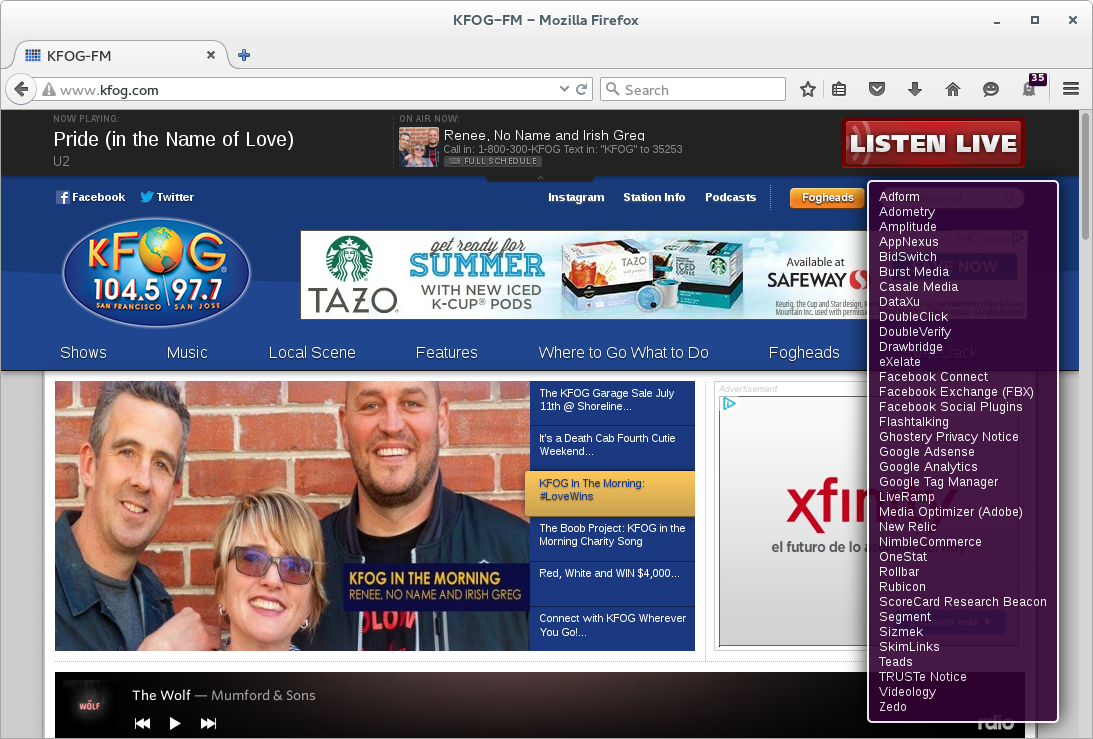
The purple bar on the right is a Ghostery list of all the trackers that are data-leaking the KFOG audience to the "adtech ecosystem."
So if a media buyer wants to reach radio listeners in the Bay Area, he or she can buy a radio commercial on KFOG (good for KFOG), buy an ad or sponsorship on the KFOG site (also good for KFOG), or just leech off the data leakage and use adtech to reach the same listeners on another site entirely (not so good for KFOG).
The radio station builds an audience, and the third-party trackers leak it away.
At the same time, a radio station can't unilaterally drop all the third-party trackers from the site. Protecting the audience is hard. That's where a radio station can use a tracking protection plan. Get the audience protected, stop data leakage, get more advertisers coming to you instead of sneaking around.
On air, when someone interferes with your signal you can call the FCC. On the Internet, well, this is getting too long, so just call Bob.
Related: news sites and the tracking game
Posted Mon 29 Jun 2015 07:07:54 AM PDT#
NIMBY + ISDS = Profit?
Random idea for how to make some cash from the Trans-Pacific Partnership.
Step 1: Buy a piece of real estate in a city with a severe NIMBY problem. (See How Strong Property Rights Promote Social Equality for more info.) Sell an ownership interest in the property to a foreign company.
Step 2: Get an architect to design a building for the site that is technically 100% legal, but that will provoke a severe NIMBY reaction. Something like "Section 8 housing for TaskRabbit workers and tech bus drivers." Put up posters and buy some newspaper ads, to get the local NIMBYs fired up.
Step 3: When the local government starts giving you grief about the building plans, don't even go to the City Council meeting. Take it straight to the International Centre for Settlement of Investment Disputes, and get the US Federal government to pay the foreign company for its investment loss.
Buy back the foreign company's share of the property and repeat. Do this enough times and a vacant lot could be more profitable than a luxury condo development. (Sucks to be a person actually looking for an apartment, but hey, are we going to do Free Trade or what?)
Posted Wed 24 Jun 2015 07:25:36 PM PDT#
One dad's FREE weight loss tip will blow your mind!
"Don, it looks like you lost weight," someone said to me last week.
That is true. Since December 2013 I have lost about 15% of my body weight.
Not a rapid decrease, but sustainable so far. I'm not at my ideal weight yet, but I have made some progress, including having to buy new pants.
The main change that I had to make was to get some kind of personal Hawthorne effect going. If I keep track of how much food I eat, and make rules for myself about when I eat food, then I'm more likely to eat the right amount.
Think of it as a kind of mindful consumption thing.
I have zero claim to be an expert on this subject. I just think of it like IT spending within a company. If my "inner CIO" is doing his job, the overall level of stuff coming in the door should be manageable, even as the users keep asking for more. Sometimes, some extra stuff will get in, over the CIO's objections, but in general, the IT department can handle it and things keep working.
So let's look at today's surveillance marketing news.

Can Mondelez, Facebook Sell More Cookies Online?
The new arrangement also covers 52 countries and will "focus on creating and delivering creative video content and driving impulse snack purchasing online," according to a statement issued on Tuesday.
Hold on a minute.
"impulse snack purchasing"
?
I'm not allowed to do impulse snack purchasing.
My inner CIO has a snack approval policy, and my inner impulsive cookie-eater has to fill out a form and wait.
So, if you want to sell me food, you have to come in the front door and pitch the mindful eating department. Or my inner CIO will set up the filters to block you.
If you want to rely on Facebook's power to manipulate emotions instead, and try to get around the CIO, you just lost your access.
David Ogilvy once
wrote,
The customer is not a moron. She's your wife.
That's being generous. The customer is a little
of both. An inner moron and an inner non-moron who
comes home and yells, What the hell did you eat
all those cookies for, you moron?
In an environment where advertisers are trying to "engage" my inner moron, information diet is a prerequisite for food diet. I don't have Facebook on my phone, and I have the web site as a mostly write-only medium (thanks to dlvr.it for gatewaying this blog). But Facebook does have an online behavioral advertising operation. In order to protect myself from that kind of thing, I have tracking protection turned on in my browser.
So if you're reading this blog for the weight loss tip, here it is. Take the tracking protection test and get protected. Bonus tip: How can I break the Facebook habit?
I'm fortunate. For me, the consequences of impulse buying are low. Yes, I like Oreo cookies, and no, I don't trust myself not to be manipulated into eating more Oreo cookies than are good for me. But it's not that big of a deal. I'm not being targeted for predatory lending or gambling. My inner CIO could have a lot worse problems.
(If anyone has a blog about mindful eating, I should probably read it to learn more about this stuff, so let me know where to find it, please.)
Photo: Balfabio for Wikimedia Commons
Posted Tue 23 Jun 2015 07:50:55 PM PDT
#
5 five-minute steps up
Jason Kint writes, in "5 Ways Industry Leaders Need To Step Up",
Needless to say I found myself shaking my head at a recent publisher event where sites were discussing how they could block Facebook from tracking their users. How on earth did this become a responsibility of the publisher to hack together a short-term solution?
It's not all the publisher's responsibility, but it's a fact of the Internet that (1) stuff keeps getting broken, often on purpose, and (2) in order for things to keep working, everyone has to keep his or her own piece safe. If you want to run a mailing list or email newsletter, you have to understand the current state of spam filtering and work on deliverability. And if you want to be on the web, you have to think about protecting your users from the problem of third-party tracking.
Do the short-term solutions right, and they don't take too much effort individually, but they turn into continuous improvement. And nobody has to wait for big, slow-moving companies to change, or worse, cooperate.
So here are five, count'em, five, quick ways to step up and make a difference in the problems of tracking-based fraud, users seeing ads as untrustworthy and blocking them, and data leakage. Should take five minutes each on a basic site, longer if you have a big hairy professional CMS.
Provide tracking warnings in page footers, to let users know when a browser is misconfigured.
Replace stock social buttons with safe versions, to avoid leaking your site's data.
Put some bonus pages behind a reverse tracking wall, to give users an incentive to get protected.
Replace confusing AdChoices links with links to a trustworthy tracking protection tool.
It's not the responsibility of an individual site to fix the whole problem, but there are plenty of small tweaks that can help slow down data leaks, encourage users to adopt site-friendly alternatives to ad blocking, and otherwise push things in the right direction.
Posted Tue 16 Jun 2015 05:46:30 PM PDT#
Team Targeting, Team Signal
Academics tend to put the conversation about the targeted advertising problem in terms of companies on one side, and users on the other. A good recent example is Turow et al:
New Annenberg survey results indicate that marketers are misrepresenting a large majority of Americans by claiming that Americans give out information about themselves as a tradeoff for benefits they receive. To the contrary, the survey reveals most Americans do not believe that ‘data for discounts’ is a square deal.
....
Our findings, instead, support a new explanation: a majority of Americans are resigned to giving up their data—and that is why many appear to be engaging in tradeoffs.
From that point of view, the privacy paradox has an almost-too-easy answer: privacy is hard. Most users aren't seeking privacy, for the same reason that they're not training for the World Series of Poker. They would prefer winning a large poker game to not winning, but they rationally expect that unless they get really good, poker playing will result in a net loss of time and money.
But the academic model that puts all businesses opposite all users is probably an oversimplification. Advertisers, agencies, publishers, and intermediaries all have different and competing interests. Businesses are not all on the same side.
In most cases, brand advertisers, high-reputation publishers, and users have a shared interest in signaling that tends to put them into an adversarial relationship with the surveillance marketing complex. The kinds of media that are good for direct response and behavioral techniques are terrible for signaling, and vice versa.
The natural dividing line is not between users and companies, but between Team Signal and Team Targeting. Team Signal includes users, legit publishers, and reputable brands—everyone who wins from honest signaling. Team Targeting is mostly adtech intermediaries, fraud hackers, low-reputation sites, and low-quality brands.
For the business members of Team Signal, the privacy poker game has a positive expected value. Which is why independent web sites can benefit by helping their users get started with tracking protection. Users, resigned or not, are not alone.
What about the agencies?
Required reading if you're into this stuff: Pitch Mania by Brian Jacobs.
Agency managers have been quick to herald this flood of pitches as proof positive that advertisers have finally recognised what they (the agencies) have been preaching for years. Their future-gazing is they say finally coming to pass. This they contend is the dawn of a new model, based around integration, joined-up thinking, big data analytics and the rest.
Are large advertisers really just looking to switch between brands of adtech/adfraud as usual? Or will an agency that wants to keep the prospective clients awake (instead of boring them with the same Big Data woo-woo as all the other agencies) do better with a tracking protection component to its pitch?
Posted Sat 06 Jun 2015 08:48:16 AM PDT#
Older stuff: archive